
SEPARATIONS
drama
Dobrica Ćosić
Co-production:
Serbian National Theatre (SNP)
National Theatre in Niš
National Theatre in Priština – based in Gračanica
ABOUT THE AUTHOR
DOBRICA ĆOSIĆ
Dobrica Ćosić (1921–2014), a writer, essayist, and politician, was one of the most significant figures in Serbian history and literature in the second half of the 20th century.
He entered the literary world in 1951 with his first novel, Far Is the Sun, the first modern novel about the Yugoslav Revolution, which presented a critique of revolutionary terror. The novel was translated into around thirty languages and, in the Soviet Union alone, was published in 1,600,000 copies.
He subsequently published the novels The Roots (1954), Divisions (1961), Fairy Tale (1965), A Time of Death – a tetralogy (1972–1979), A Time of Evil – a trilogy consisting of The Sinner (1985), The Renegade (1986), and The Believer (1990), as well as A Time of Power I (1996) and A Time of Power II (2007).
He received numerous literary awards, including the NIN Award, which he won twice, for the novels The Roots and Divisions. In 1986, the Association of Writers of Serbia awarded him the Association of Writers of Serbia Award for his outstanding contribution to literary creation. He also received the traditional annual award of the National Library of Serbia twice for the most widely read domestic book.
On the occasion of his seventieth birthday, in 1991, he received the Special Vuk Award. In May 2010, in Moscow, he became the first recipient of the “Pushkin” Award for outstanding achievements in literature. At the First Slavic Arts Forum “Golden Knight,” Valery Ganichev, President of the Writers’ Union of Russia, presented him with the “Golden Knight” Award for literary achievement.
Dobrica Ćosić’s works have been translated into around thirty languages.
“Divisions is a work that defines an era, an epic and a drama at the same time.”
— Petar Džadžić
“A magical book.”
— Oskar Davičo
“Divisions is an act of intellectual honesty and the author’s readiness to confront the pulsating conscience, his own or someone else’s. A poignant and compelling evocation of the cataclysm of man in war and the arduous suffering of Serbia.”
— Milan Vlajčić
DIRECTOR’S BIOGRAPHY
JUG RADIVOJEVIĆ
He was born on March 1, 1972, in Belgrade.
He completed primary school, lower music school, and high school in Vranje, where, alongside his father Radoslav, a director and actor, his mother Ljiljana, an actress, and his sister Ana, an actress and director, he took his first steps in theatre at the Bora Stanković Theatre.
He graduated in Theatre and Radio Directing from the Faculty of Dramatic Arts in Belgrade, in the class of Professor Dr. Svetozar Rapajić.
To date, he has directed 119 theatre productions in theatres throughout Serbia and the region, receiving more than fifty awards for both directing and the productions as a whole at the most important national, regional, and international theatre festivals.
He received the Dr. Hugo Klein Foundation Award for Best Directing Student in 1993/94.
From 2000 to 2004, he was a resident director at the Yugoslav Drama Theatre.
From 2004 to 2007, he worked as an assistant professor at the Faculty of Dramatic Arts in Belgrade, teaching Acting.
Since 2017, he has been a resident director of the Drama Department of the National Theatre in Belgrade.
Since 2019, he has served as Director of the Belgrade Drama Theatre.
He is Chairman of the Board of Directors of the Bitef Festival.
The production Divisions is his 120th directorial work and his second production at the Serbian National Theatre.
Directing Credits:
At the Serbian National Theatre:
-
M. Vitezović: Svetozar
At the National Theatre in Niš:
-
D. Dukovski: Who the Hell Started It First
-
G. Feydeau: The Duchess of Folies-Bergère
-
D. Stojiljković: Constantine – a co-production with the National Theatre in Belgrade
At the National Theatre in Priština:
-
S. Mrożek: The House on the Border
-
B. M. Mihiz: Prince Marko
-
D. Kovačević: The Collection Center
-
J. Radulović: The Pigeon House
-
S. Shepard: Fool for Love
FROM THE DRAMATURGE’S NOTES ON DIVISIONS
Almost everywhere we turn, we hear about some kind of divisions in Serbia. From (pseudo-)political ones: “the First and Second Serbia,” “civil and national Serbia,” “left- and right-wing Serbia,” “the government and the opposition,” “boycott and electoral opposition,” to religious, national, vaccination-related, sports, geographic, gender, generational, and other divisions… The list of divisions seems endless.
No matter how porous the boundaries between opposing sides essentially are, it is the willingness of their representatives to engage in mutual confrontation to the point of annihilation that creates a sense of unease and repeatedly raises the question of the purpose and necessity of such divisions.
The Second World War is, without a doubt, both a metaphor and a metonymy for the bloody divisions in Serbia. Its echoes can still be heard today. The decision to respond to the various divisions in Serbian society through a theatre production, while also marking 80 years since the beginning of the wartime conflicts in Serbia and the former Yugoslavia during the Second World War (1941–1945), is more than logical and justified. The significance of this event for the modern history of Serbia is immeasurably great.
One of the most important works of Serbian literature after the Second World War, Ćosić’s Divisions (1961), attracted considerable attention from both readers and critics because of its thematic and formal departure from the dominant literary model of socialist realism at the time.
The novel explores divisions: revolution/counterrevolution, violence/non-violence, upper/lower classes, domestic/foreign, old/young, heroism/cowardice, peasant/civilian, male/female, as well as family and social attitudes, predominantly from the perspective of the Ravna Gora movement, which at the time the novel was published represented the defeated side.
The thematic shift and the changed perspective from which the axes of conflict are viewed are accompanied by a compositional departure from a clear linear narrative, the blending of fiction and fact, in which the seemingly distinct voices of individuals become intertwined into a single voice of a people bewildered by its historical moment.
The main characters of the novel are descendants of the Katić and Dačić families, thus linking Divisions to The Roots and making it part of the most significant saga in Serbian literature of the 20th and 21st centuries (The Roots, A Time of Death, A Time of Evil, The Renegade, The Sinner, A Time of Power…).
These thematic and compositional elements directed the dramatization process toward identifying the collision between non-verbal action, soliloquy, monologue, and dialogue within each dramatic situation.
This collision provides an opportunity to search, both in the novel and in the dramatic text, for those qualities that irony, in its unifying experience, simultaneously emphasizes and negates. The process of ironization is based on establishing an antithesis between two worlds and two ways of thinking that mirror one another like reflections in a distorted mirror.
The principal ironic effect is achieved by interpreting one world through the terms belonging to another, from which analogous value judgments emerge. The conflicts of the historical moment that are thematized are resemanticized at both their poles into an undefined, amorphous state characteristic of representations of the period preceding a new beginning in the genealogical tree, corresponding to the experience of the “eternal return of the same.”
Writing of both collective and personal tragedy, Ćosić begins the novel with Nazi Germany’s attack on the Kingdom of Yugoslavia in 1941 and concludes it with the events surrounding liberation in the autumn of 1944.
He selected and developed the characters according to their social background and life choices, thereby encompassing all the social strata on which the opposing sides—the Ravna Gora and Partisan movements—relied.
From the multitude of characters and perspectives offered by the novel, the dramatization process singled out the most significant representatives, whose individual traits and narrative lines bring together the traumatized experience of division and the disintegration of society, family, and the individual.
At the same time, the fragmentation and reshaping of time, the experience of contemporary theatre, the grotesque similarities between the traumas of the wars of the 1990s and the divisions of the 21st century, and the playful approach to form—in which the Chorus, as a plurality of individual destinies and voices, preserves the memory of Greek tragedy while also becoming an omniscient narrator, something akin to a social network, a group of selected avatars gathered around the retelling of the fate of Uroš Babović and the inhabitants of the villages of Prerovo and Trnava—form the starting point of this dramatization process and a possible basis for its stage interpretation.
The characters are constructed as semiotic clusters, whose more complete map of distinctive features makes it possible to conceive the entire production as a movement of the masses, in which the sparks of individual destinies become both an icon and an index of the society we represent and to which we speak here and now.
The titanic struggle between the two complexes, the Laius and Oedipus complexes, and their questions—why do parents want to kill their children, and why do children want to kill their parents?—seems to take on an extreme form in Serbia: everyone against everyone and each against each.
And so, one somehow manages—or fails to manage—to find one’s way through the thing we call life.
Moving through different layers of consciousness, subconsciousness, and reality with every one of its elements, through different associations, organizing the characters and acting expression around an entire series of thematic axes, Divisions endures as an aggregate of potentially unlimited and ever-new interpretations.
Spasoje Ž. Milovanović
DRAMATURG’S NOTE
In order to bring Ćosić’s Deobе to the stage, it was necessary to make a drastic selection from the numerous individual divisions that abound in the novel. Only after that essential line had been drawn, and Uroš Babović’s personal and family tragedy had been placed in the foreground, did Ćosić’s Deobе become theatrical Deobе.
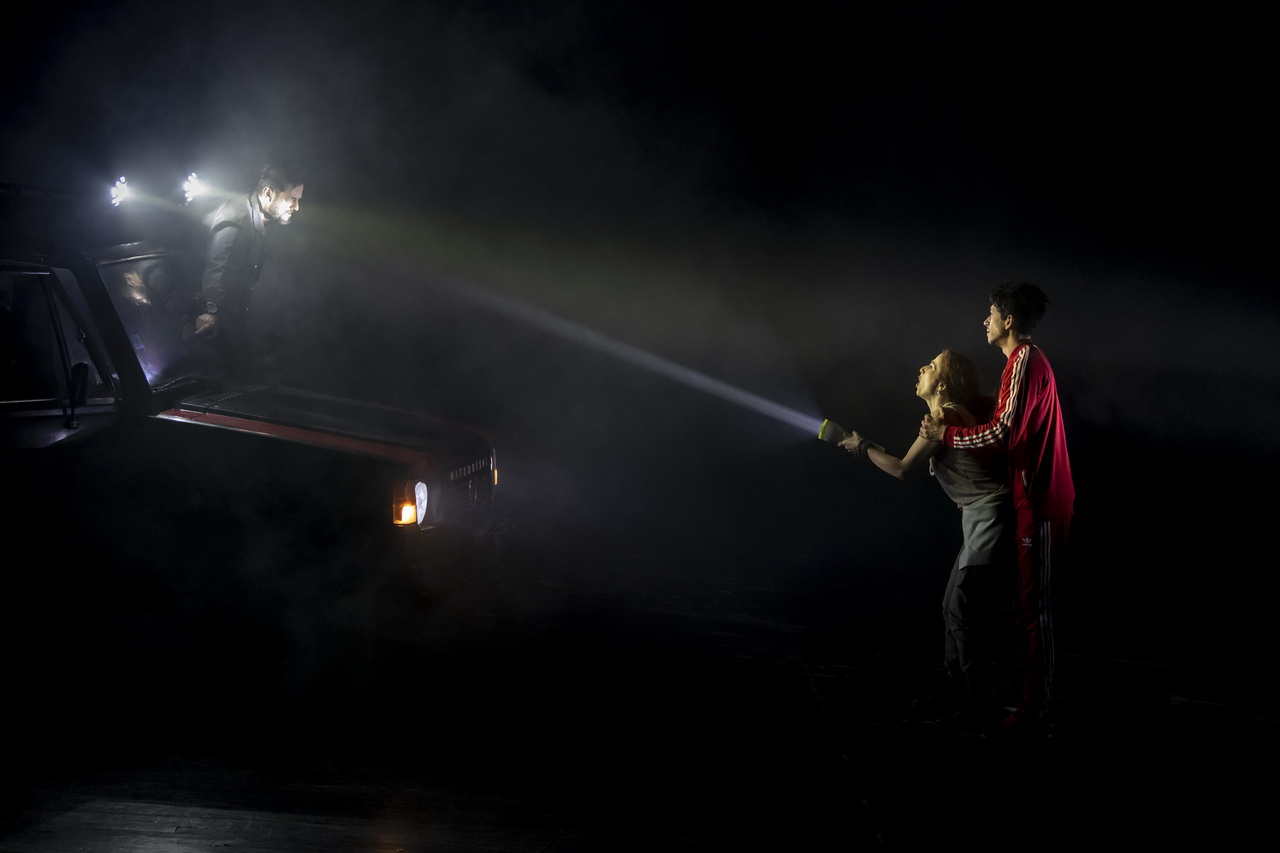
Once our impressions of the aesthetics (and the message) of what we have seen on stage have settled, even if our opinions differ, I believe that we will all (or almost all) agree on one thing: regardless of their theatrical form, these Deobе, in their essence, most closely resemble ancient drama.
Božidar Knežević
When is this performance playing?
You can find all upcoming dates on the Repertoire page.
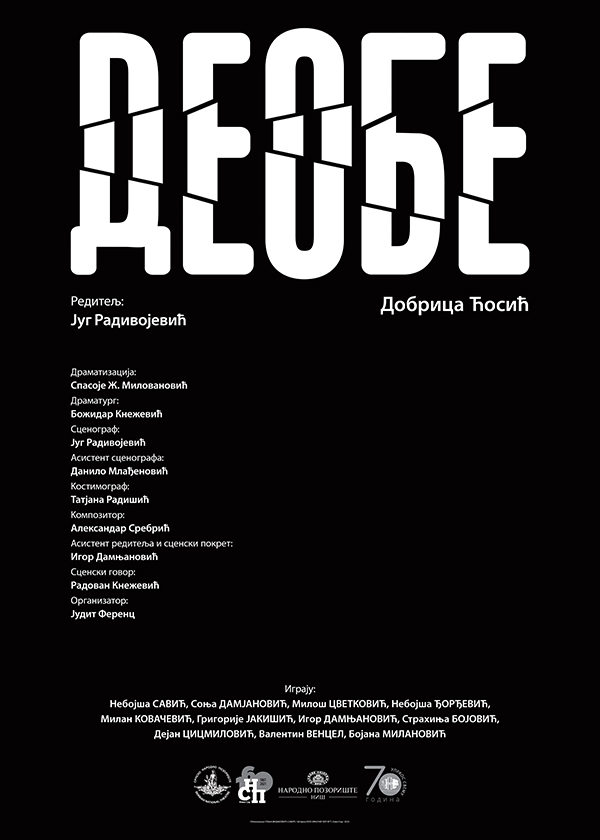
BASIC INFORMATION
Genre
Drama
Age
14+
Premiere
March 11, 2021
Stage
Main Stage
CREATIVE TEAM
Text
Dobrica Ćosić
Direction, Set Design
Jug Radivojević
Dramatization
Spasoje Ž. Milovanović
Dramaturg
Božidar Knežević
Assistant Set Designer
Danilo Mlađenović
Costume Designer
Tatjana Radišić
Composer
Aleksandar Srebić
Assistant Director and Movement Director
Igor Damnjanović
Stage Speech
Radovan Knežević
Production Coordinator
Judit Ferenc
Photography
Srđan Doroški
CHARACTERS
Uroš Babović, village landowner
Nebojša Savić
Vida, his wife
Sonja Damjanović
Miloš, their son
Miloš Cvetković
Vita, their servant
Nebojša Đorđević
Adam Katić, village landowner
Milan Kovačević
Dušan Katić, student, his son
Grigorije Jakišić
Ljubiša Dačić, their servant
Igor Damnjanović
Doctor, civilian politician
Strahinja Bojović
Kosta Cvetić, major
Dejan Cicmilović
German officer
Valentin Venzel
Bride
Bojana Milanović
TECHNICAL CREW
SNP Technical Crew – Stage Manager
Vladimir Savin
SNP Technical Crew – Prompter
Snežana Kovačević
SNP Technical Crew – Special Effects
David Kuzmanović
SNP Technical Crew – Lighting Technician
Miroslav Čeman
SNP Technical Crew – Sound Technician
Vladimir Ognjenović
SNP Technical Crew – Costume Assistant
Snežana Horvat
National Theatre in Niš Technical Crew – Stage Manager
Vladislav Đorđević
National Theatre in Niš Technical Crew – Sound Design
Slobodan Ilić
National Theatre in Niš Technical Crew – Lighting Design
Dejan Cvetković
National Theatre in Niš Technical Crew – Lighting
David Jovanović
National Theatre in Niš Technical Crew – Prompter
Vanja Šukleta
Technical Director
Dejan Mitić
Stage Manager
Slaviša Filipović
Set Decorators
Srđan Kitanović, Miodrag Đorđević, Marin Rajić, Rade Pešić, Mića Lazarević
Props Master
Marko Đorđević
Wardrobe
Dušica Mladenović, Marko Dinić, Katarina Filipović
Make-up and Wig Artists
Ljiljana Rašić, Marija Cvetanović, Ivana Lazarević
Procurement
Zoran Denčić