
BLUEBEARD’S CASTLE
opera
Béla Bartók
ABOUT THE OPERA AND THE COMPOSER
Béla Bartók (1881–1945) was one of the most significant composers of the 20th century and a central figure in musical modernism. His work combines elements of folk musical heritage with contemporary compositional expression, through which he developed a unique and recognizable musical language.
Bluebeard’s Castle (1911) is Bartók’s only opera. The libretto by Béla Balázs, based on the well-known tale of Bluebeard, is shaped as a symbolic drama between two characters. The external action is reduced to a minimum, while the focus shifts to their inner states and relationship.
The opera emerged from a deeply personal impulse. Bartók wrote it and dedicated it to his then-wife, Márta Ziegler, as a wedding gift. Nevertheless, despite this private point of departure, Bluebeard’s Castle transcends its autobiographical framework and becomes a universal story about trust, the need for truth, and the boundaries of emotional intimacy.
The castle’s seven doors do not represent specific spaces, but rather symbolic layers of Bluebeard’s past, memories and inner fears. Judith’s decision to open every door stems from her need for complete understanding and intimacy, while Bluebeard resists this exposure, aware that revealing everything would also mean losing his inner balance.
The opera is performed with piano accompaniment rather than a full orchestration, further emphasizing the relationship between the two characters and the psychological dimension of the drama.
BIOGRAPHY OF THE DIRECTOR
Jovana Solunović Mitrović is an opera and theatre director. She graduated in Opera Singing from the University of Niš, in the class of Aleksandra Ristić, and completed her Master’s degree in Art and Media Theory at the University of Arts in Belgrade, under the mentorship of Dr Vesna Mikić. She earned her Master’s degree in Theatre Studies at the University of Bergen, under the mentorship of the Scandinavian theatre scholar Knut Ove Arntzen, where she also completed additional studies in pedagogy, Italian Studies, and English Language and Literature. In 2025, she received her PhD in Theatre Directing from the Faculty of Contemporary Arts in Belgrade, in the class of Božidar Đurović.
Her work focuses on opera and musical theatre, with particular emphasis on psychological dramaturgy, contemporary directing approaches, and the use of digital technologies in stage expression. She directed Stevan Binički’s opera At Dawn at the National Theatre in Niš, as well as Grigori Frid’s mono-opera The Diary of Anne Frank, which has been performed in Serbia and presented internationally in the Netherlands and Norway.
As an assistant director, she has worked on opera productions in Berlin, including W. A. Mozart’s The Marriage of Figaro and E. Humperdinck’s Hansel and Gretel. Her production of Verdi’s opera Rigoletto is currently in preparation in Vienna for the 2026 season. She is an active member of the European opera network RESEO and, alongside her artistic work, is also engaged in teaching music and performing arts.
DIRECTOR’S NOTE
I view Bluebeard’s Castle as a psychological drama about the relationship between two people who long for intimacy but approach it along different paths. Judith’s need to see and understand every part of Bluebeard’s inner world stands in contrast to his need to keep certain spaces closed as a way of protecting his inner self.
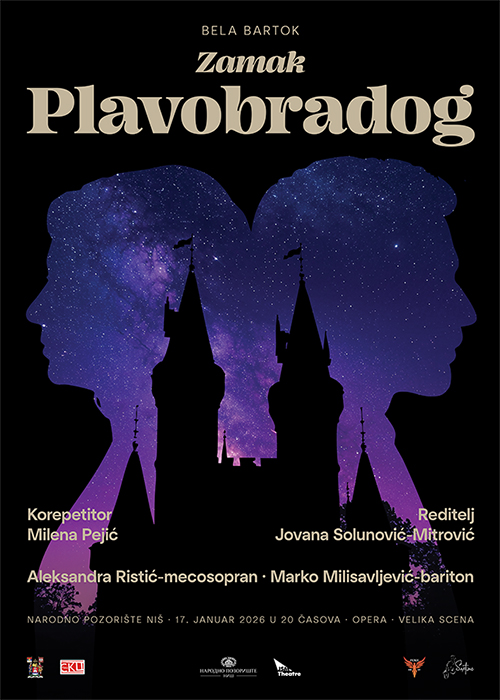
In this production, the castle is not a physical place, but an inner space—the mental and emotional landscape of Bluebeard’s character. The doors are not physical obstacles, but symbols of the memories, experiences and traumas he carries within him. By setting the action in the Victorian era, the atmosphere of control, tension and suppressed emotions is further emphasized.
Performing the opera with piano accompaniment allows for a concentrated and stripped-down stage expression, in which music and text directly follow the psychological dynamics of the characters. Within this framework, the drama does not unfold through spectacle, but through the gradual revelation of their relationship, ultimately leaving both Judith and Bluebeard in a state of silence and confinement.
When is this performance playing?
You can find all upcoming dates on the Repertoire page.
BASIC INFORMATION
Genre
Opera
Age recommendation
14+
Premiere
January 17, 2026
Stage
Main Stage
CREATIVE TEAM
Composer
Béla Bartók
Libretto
Béla Balázs
Director
Jovana Solunović Mitrović
Assistant Director
Aleksandar Prike Stevanović
Rehearsal Pianist
Milena Pejić
Set and Video Designer
Miloš Mitrović
Costume Designer
Vladimir Pekić
Intendant
Ana Savić
Translation and Adaptation of the Libretto into Serbian
Miloš Milisavljević
Organizer
Ivana Madić Stojanović
CAST
Judith
Aleksandra Ristić – mezzo-soprano
Bluebeard
Marko Milisavljević – baritone
TECHNICAL TEAM
Stage Manager
Aleksandar Stevanović
Lighting Design
Dejan Cvetković, Jovana Solunović Mitrović
Lighting
David Jovanović, Dejan Cvetković
Multimedia Operator
Slobodan Ilić
Supertitles Operator
Damjan Mišić
Technical Director
Dejan Mitić
Stage Technician
Radomir Pešić
Set Crew
Srđan Kitanović, Miodrag Đorđević, Mića Lazarević, Nemanja Perić, Marin Rajić
Props Master
Dragan Nikolić
Dresser
Katarina Pavlović
Makeup and Wig Artist
Milica Denčić Stanković
Tailoring
Vladimir Pekić